Best Bridgestone tyres for desert driving in the UAE
Quick answer
For UAE desert driving, the Bridgestone Dueler A/T 002 is the best all-round choice: it handles soft sand at 15–18 PSI and still drives calmly on the E11. The A/T 001 is the lower-cost alternative, the M/T 674 suits rocky wadis and heavy builds, and a Dueler H/T only suits occasional, gentle sand.
Key takeaways
- Dueler A/T 002 is the best balance of dune grip and highway manners for most UAE 4x4 owners.
- Air down to around 15–18 PSI for soft sand, and reinflate to the door-placard pressure before you rejoin tarmac.
- Aired-down sidewalls are vulnerable on gravel and rock; slow down on stony tracks and inspect after every trip.
- Never go into the dunes alone: travel in convoy with recovery gear, water and a charged phone, and call 999 in an emergency.
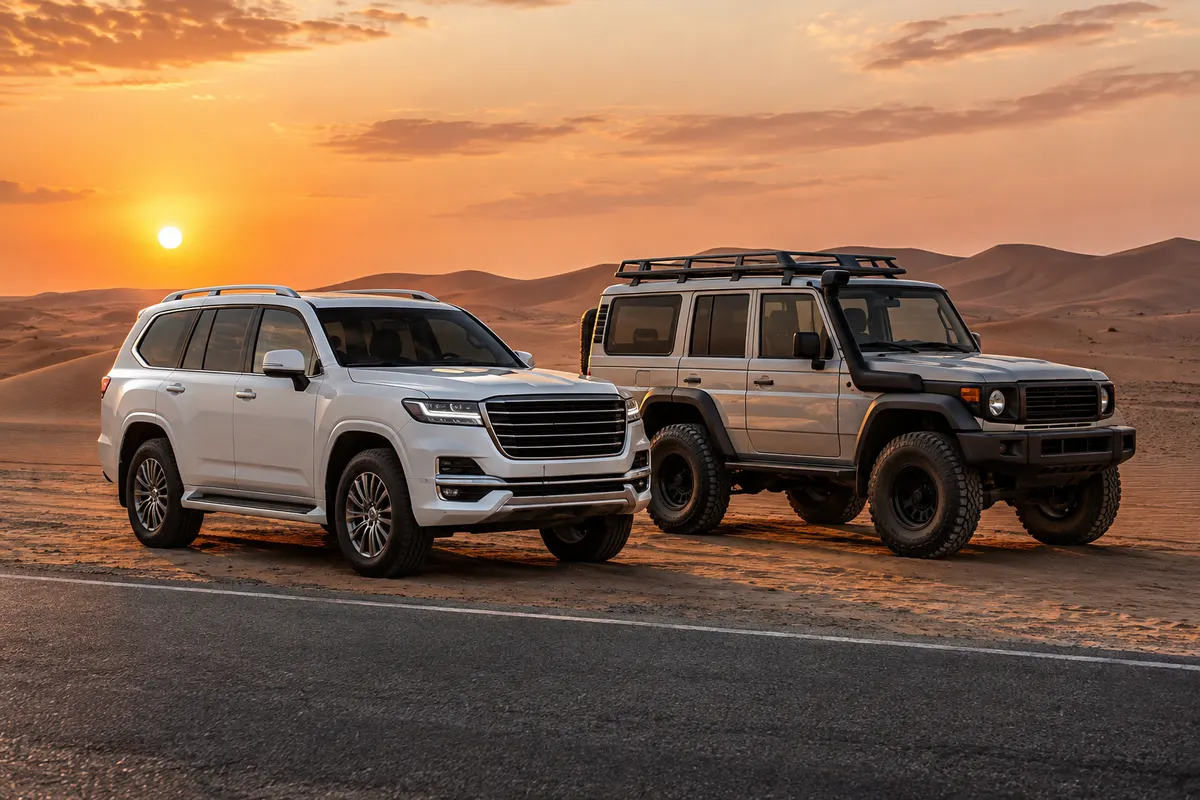
Every winter weekend the vans get the same Thursday-night calls: a Patrol or Land Cruiser heading to Al Qudra, Big Red or Liwa, and the owner wants to know whether the tyres on it will cope. Sometimes they will. Sometimes the tyre on the car is a road-only touring pattern that has no business on a dune.
This guide compares the Bridgestone tyres we fit for sand, from the Dueler A/T 002 to the M/T 674, and covers the habits that matter as much as the tyre: airing down, reinflating, protecting sidewalls and getting home safely.
Which Bridgestone tyre is best for sand driving in the UAE?
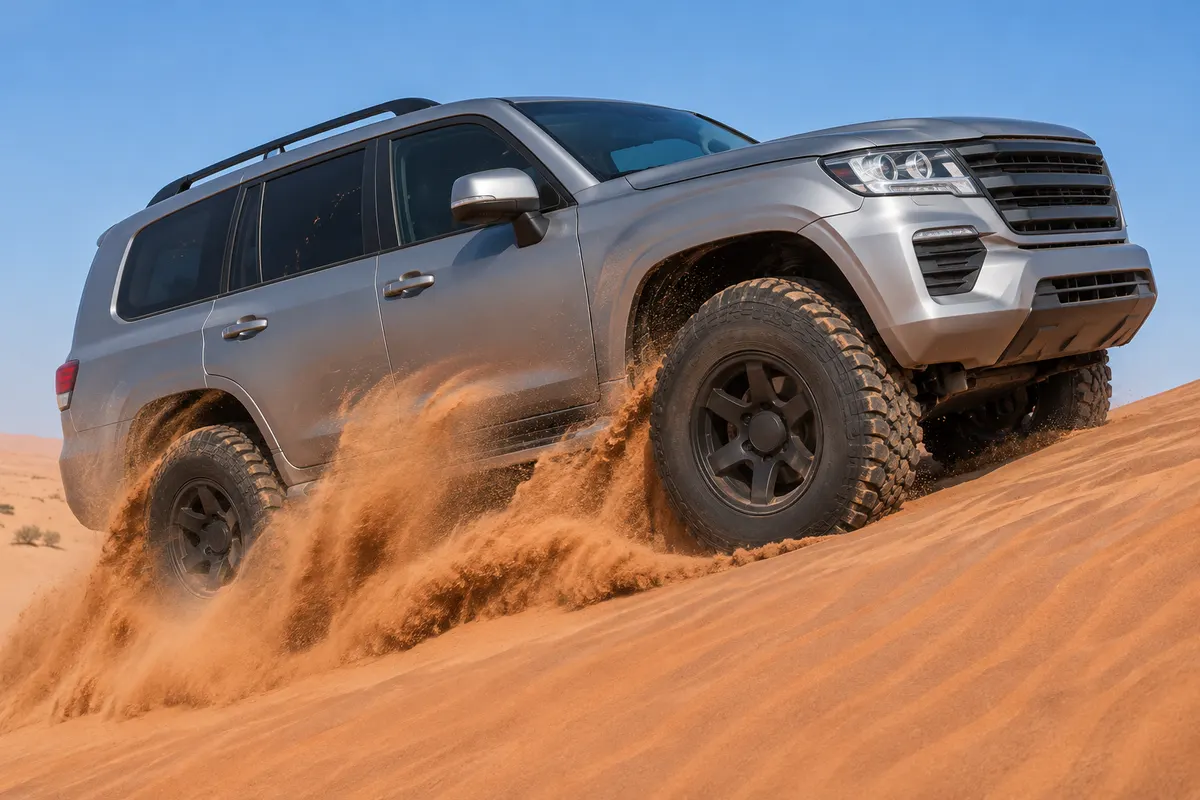
The Bridgestone Dueler A/T 002 is the best sand tyre for most UAE drivers because it combines a flexible, open tread for flotation with a construction that stays composed at 120 km/h on the way home. Most people who go to the desert drive two hours of highway for every hour on sand, and the tyre has to be good at both.
The A/T 002's shoulder blocks give the tyre a wider, more even footprint once aired down, which is what keeps a heavy 4x4 on top of soft sand instead of digging in. On tarmac it is quieter than you would expect from an all-terrain.
If you want the full off-road range in one place, the Bridgestone 4x4 off-road tyres UAE page lists every Dueler pattern we stock with sizes.
Dueler A/T 002 vs A/T 001: which should you buy?
The Dueler A/T 002 is the newer generation of Bridgestone's all-terrain tyre, and the A/T 001 is the earlier pattern that is still widely available and often slightly cheaper. Both are genuine all-terrains that work on UAE sand when aired down properly.
In my experience the A/T 002 feels more settled on the highway and its tread holds its shape well as it wears. The Dueler A/T 001 remains a solid choice when budget matters or when your exact size is only available in the older pattern.
Whichever you choose, keep the set matched. A mix of A/T 001 on one axle and A/T 002 on the other is legal, but on a full-time 4x4 I prefer four of the same so the tread depth and grip stay even front to rear.
| Pattern | Best for | Soft sand | Highway comfort | Typical price |
|---|---|---|---|---|
| Dueler A/T 002 | Regular dunes plus daily driving | Very good | Good | From around AED 520 |
| Dueler A/T 001 | Sand on a tighter budget | Good | Good | From around AED 480 |
| Dueler M/T 674 | Rock, wadis, modified builds | Good with careful throttle | Fair, louder | From around AED 750 |
| Dueler H/T 684 II / H/T 840 | Mostly roads, occasional easy sand | Fair | Very good | From around AED 450 |
When does the Dueler M/T 674 make sense for the desert?
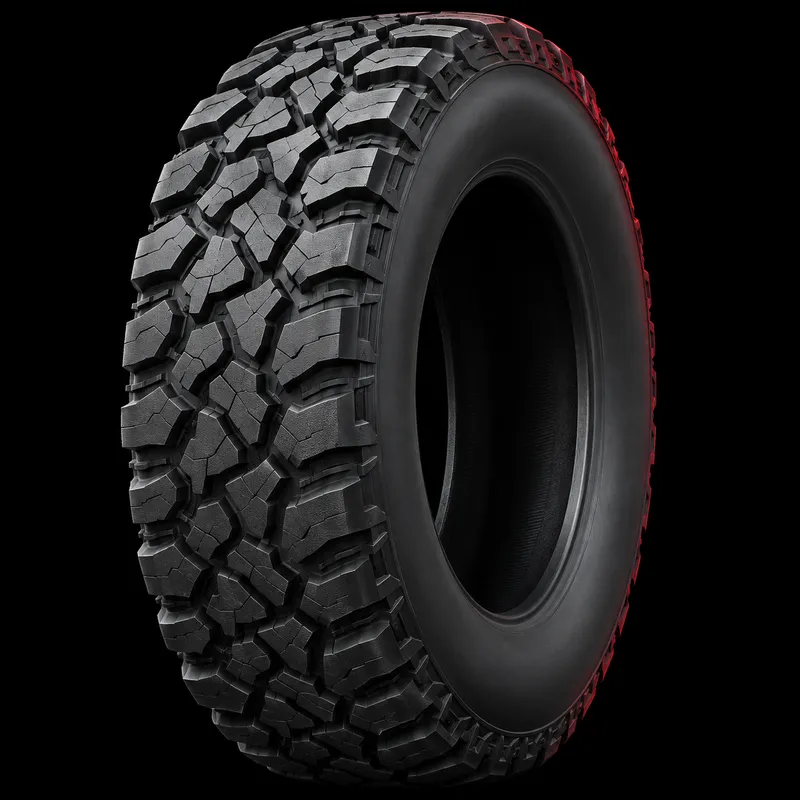
The Dueler M/T 674 makes sense when your off-road driving includes rock, wadi beds and broken gravel, not only sand. It is a light-truck mud-terrain tyre with a tough carcass and large lugs, so it shrugs off sharp stones in Hatta and the mountain tracks of Ras Al Khaimah and Fujairah.
On pure soft sand it is not automatically better than an A/T. The big voids can dig if you are heavy on the throttle, and the stiffer construction needs careful airing down to get a good footprint. Drivers who know how to feather the throttle do well on it.
On the road, the Dueler M/T 674 is louder and heavier, and you will feel it in fuel use and braking. I recommend it mainly for modified Wranglers, lifted Patrols and builds that spend real time on rocks.
Can you take a Dueler H/T on the dunes?
A Dueler H/T can handle flat desert tracks and the occasional easy dune if it is aired down, but it is not built for regular dune bashing. Its tighter highway tread clogs less on sand than people fear, yet the sidewall and shoulder are designed for road loads, not repeated flexing at low pressure.
For the firm, graded tracks around Al Qudra Lakes, an H/T 684 II at reduced pressure is usually fine. For the steep faces at Big Red or the tall dunes around Moreeb in Liwa, I would not choose it.
If your 4x4 does a winter camping trip or two, an H/T plus careful driving is a reasonable compromise. If you go out most weekends, move to an A/T.
What tyre pressure should you use for dune bashing?
For soft UAE sand, most 4x4 drivers air down to around 15–18 PSI, from a road pressure that is usually 30–35 PSI on the door placard. Lower pressure lengthens the footprint, so the tyre floats over sand instead of cutting into it.
Going much below 15 PSI increases the risk of the tyre rolling off the rim bead in a sharp turn, especially on a heavy car or with a stiff light-truck tyre. If you do run lower in very soft sand, keep speeds low and steering smooth.
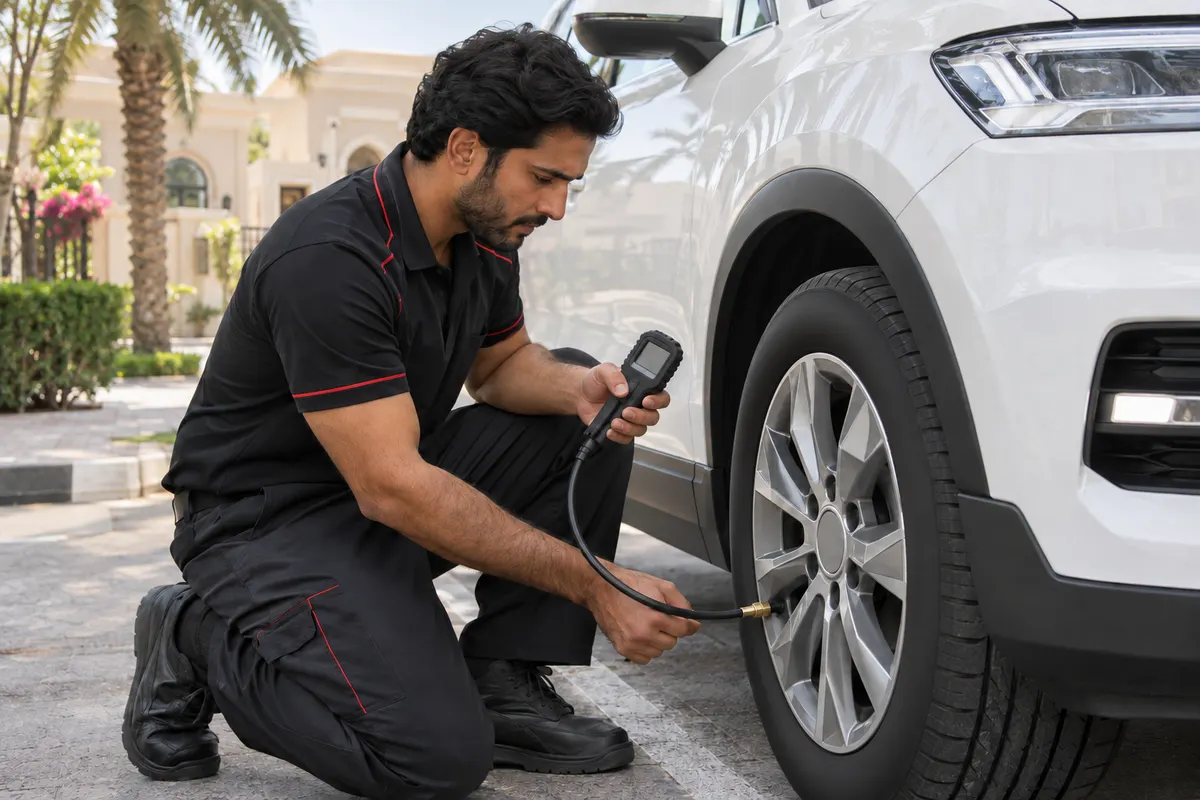
Use a proper gauge rather than counting seconds on the valve, and air down all four tyres to the same pressure. Our Bridgestone tyre pressure guide for the UAE covers road pressures by vehicle type.
- Firm desert tracks: around 20–25 PSI.
- Soft dunes (Al Qudra, Big Red, Liwa): around 15–18 PSI.
- Recovery from being stuck: briefly lower, then back up as soon as you are free.
Why must you reinflate before driving back on tarmac?
Driving on tarmac at 15–18 PSI makes the sidewall flex far more than it was designed to, which builds heat fast and can lead to tread separation or a blowout. On a summer afternoon with road surfaces at 60–70°C, the risk climbs quickly at highway speed.
Carry a good 12V compressor and reinflate to the door-placard pressure at the edge of the sand, before you join the road. Do not count on finding air close to the dunes. If you have to drive a short distance first, keep it slow.
After a desert weekend, a quick tyre pressure check is worth it. Small slow leaks from sand in the bead or a damaged valve often show up a day or two later.
How do gravel and rocks damage aired-down tyres?
Aired-down tyres bulge outward, which exposes the sidewall to sharp gravel and rock, the most common cause of non-repairable desert damage I see. Sidewall cuts cannot be safely patched, so one bad stone means a new tyre.
The gravel approach tracks to some desert camps and the stony patches between dunes are where most of this happens. Slow right down on stony ground, pick your line around sharp rocks and, if a long gravel section is ahead, add a few PSI back first.
After every trip, walk around the car and look for cuts, bulges or chunks missing from the shoulder. A bulge means the internal cords are damaged and the tyre should be replaced before the next highway drive. A nail in the tread, by contrast, can often be fixed with a proper puncture repair.
How do you stay safe on a desert drive?
The safest desert trips follow one rule: never go alone, and always tell someone where you are going and when you expect to be back. Even experienced drivers get stuck, and a second car with a recovery strap turns a crisis into a ten-minute job.
Carry more water than you think you need, a shovel, a recovery strap with soft shackles, a tyre gauge, a compressor and a basic first-aid kit. Check the weather and avoid the dunes in the hottest part of a summer day. If someone is injured or a car rolls, call 999 straight away and give your location as precisely as you can.
The right tyres are only one part of preparation. For owners of the big Toyota and Nissan 4x4s, my guide to Bridgestone tyres for the Land Cruiser and Patrol covers sizes and load ratings.